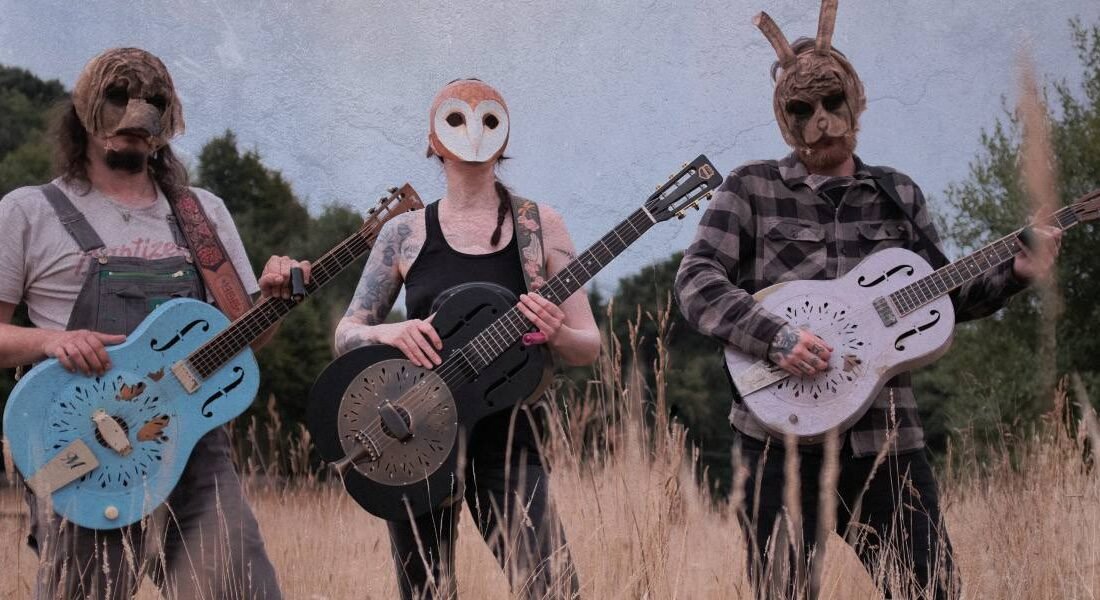
Some artists approach the blues as a catalogue to study. Others treat it as a place they’ve come to know intimately—somewhere they return to, reshape, and carry forward. The Curse of K.K. Hammond belongs in that second camp. Over the past few years, she’s carved out a distinctive path, rooted in early Delta traditions but filtered through a darker, more atmospheric lens. With her latest version of “Ain’t No Grave,” alongside David & the Devil and Kaspar “Berry” Rapkin, she revisits one of the most enduring songs in the American canon and finds a way to make it feel grounded rather than overfamiliar.
The song’s origins are well documented, most often tied to Brother Claude Ely’s 1930s recording. It has since passed through countless hands, each adding something of their own. That long history can be both a strength and a challenge. Any new interpretation risks either repeating what’s already been done or straying too far from the source.
Hammond avoids both traps by pulling back.
The arrangement is patient. It doesn’t rush to make an impression. Slide guitar lines drift in and out, not as decoration but as part of the atmosphere. The rhythm holds a steady pace, allowing the song to settle rather than pushing it forward. There’s a sense of space throughout, and that space becomes part of the performance.
Her vocal follows the same line of thinking. There’s no attempt to force drama into the delivery. Instead, she leans on tone and phrasing, letting the lyric carry its own weight. When she reaches the refrain—“Ain’t no grave gonna hold my body down”—it lands with a quiet certainty. It doesn’t need to be raised in volume to be effective. It simply holds its ground.
David & the Devil adds a second perspective that deepens the track. His voice carries more grit, and the contrast between the two performances creates a subtle tension. They don’t merge into a single sound; they move alongside each other, giving the song a sense of shared experience rather than a single viewpoint. It’s a reminder of how these songs often evolved—through multiple voices contributing to the same narrative.
Rapkin’s production keeps everything in balance. The recording isn’t polished to the point of losing character. Small details remain—the sound of fingers on strings, the natural decay of notes, the space between phrases. Those elements give the track a sense of immediacy, as though it’s happening in real time rather than being assembled piece by piece.
The video complements that approach. Shot with an emphasis on mood, it relies on shadow, natural light, and open settings to reflect the tone of the music. It doesn’t attempt to tell a defined story. Instead, it reinforces the atmosphere, leaving room for interpretation.
Looking back at Hammond’s career, this release feels like a natural progression. Her debut album, Death Roll Blues, introduced her as an artist willing to engage deeply with traditional forms while adding her own perspective. That record found a wide audience, topping blues charts in both the UK and the United States and earning recognition beyond the usual circles.
Since then, her collaborations with Rapkin and David & the Devil have expanded her reach. Tracks like “Walk With Me Through the Fire” and her reworking of “Heart Shaped Box” showed a willingness to move beyond strictly traditional material without losing her identity. The visual side of her work—often understated but carefully considered—has also become an important part of how her music is experienced.
Ain’t No Grave brings those elements together. It doesn’t try to reinvent the song in a dramatic way. Instead, it refines her approach, focusing on clarity and intention.
What emerges is a version that feels connected to its origins without being confined by them. Hammond isn’t attempting to define the song for a new generation. She’s adding her voice to its ongoing history.
And sometimes, that’s the most meaningful contribution an artist can make.
–Chris Morton


The Woman Who Listened to Water: Inside the Unconventional World of Elvira Kalnik
Jun 5, 2026
Holding Fast: Ashley Puckett, “Anchor” and the Strength Found in Vulnerability
May 21, 2026